
903 Physical Therapy
Whitesboro, Tx
Physical Therapist or Chiropractor? How to Decide
Oct. 23rd 2024
By 903 Physical Therapy PLLC
Both treat musculoskeletal pain and both appear in national treatment guidelines, so neither is the wrong answer. The practical difference is emphasis. Chiropractic care centers on spinal manipulation for symptom relief. Physical therapy centers on movement assessment and exercise to change what caused the problem. For a sudden stiff back, either is reasonable. For pain that keeps coming back, the exercise-based route is usually the better fit.
What is the actual difference?
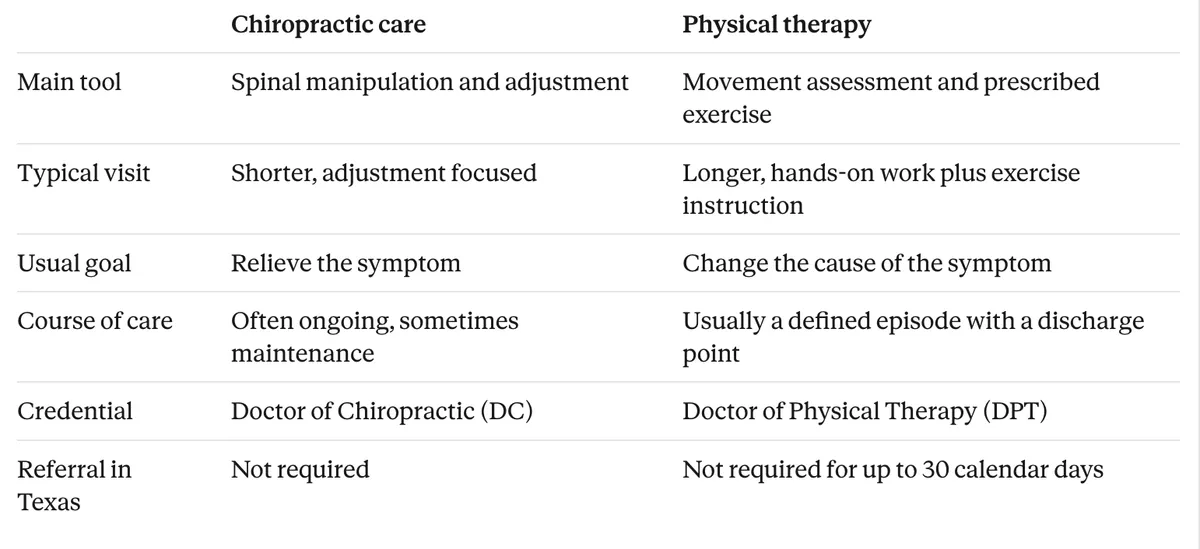
The overlap is bigger than most people assume. Many physical therapists perform joint manipulation and mobilization. Many chiropractors prescribe exercise. You cannot cleanly divide them by technique. The difference shows up over a course of care. A chiropractor’s main tool is spinal manipulation, and the usual goal is relieving the symptom in front of you. Visits tend to be shorter and adjustment focused, and care is often ongoing, with some people continuing on a maintenance schedule. A physical therapist’s main tool is movement assessment and prescribed exercise, and the usual goal is changing what caused the symptom in the first place. Visits tend to run longer, combining hands-on work with exercise instruction, and care is usually a defined episode with a point where you are discharged. The credentials differ as well. A chiropractor holds a Doctor of Chiropractic degree, shortened to DC. A physical therapist holds a Doctor of Physical Therapy degree, shortened to DPT. In Texas you can see either one without a doctor’s referral, though the rules are not identical. Chiropractors require no referral at all, while a qualified physical therapist can treat you without one for up to 30 consecutive calendar days. Neither approach is better. They answer different questions.
What do the treatment guidelines say?
Both are recommended, which is worth saying plainly. The American College of Physicians guideline on noninvasive treatment of low back pain lists spinal manipulation among the options to try first for acute and subacute back pain, alongside superficial heat, massage and acupuncture. For chronic low back pain, it lists both exercise and spinal manipulation among the first-line options, alongside multidisciplinary rehabilitation, acupuncture, yoga, tai chi, motor control exercises and several others. Two things in that guideline matter more than the lists. First, non-drug treatment comes before medication. The guideline positions an NSAID as what you consider when the non-drug options have not worked. Second, the honest part: most of the evidence behind these recommendations is rated low to moderate quality, and the measured effects are described as minimal to moderate. Anyone telling you their approach is dramatically proven is overselling. Both professions do this. One caution on how this guideline gets quoted. It recommends treatments, not professions. It does not say who should deliver spinal manipulation or exercise, and the words physical therapy and chiropractic do not appear in the summary recommendations at all. When a clinic of either kind tells you the ACP endorsed them specifically, they are stretching it.
When a chiropractor is the better first call?
Some honest cases: You want manipulation specifically and you have had good results with it before Sudden onset neck or back stiffness where the main goal is getting moving again quickly You prefer shorter, more frequent visits over longer exercise-based sessions You already have a chiropractor you trust and the problem is similar to one they have resolved before If that is your situation, go. You do not need a referral for that either.
When a physical therapist is the better first call?
The problem keeps returning after it resolves. Recurrence usually means something about how you load or move has not changed The pain is not spinal. Shoulders, knees, hips, ankles and hands are the daily work of physical therapy You are recovering from surgery or a specific injury Weakness, balance problems or difficulty with a specific activity, rather than pain alone You want to know why it happened, not only to feel better this week The problem is neurological in origin, such as after a stroke, or involves dizziness and balance A useful rule: if the question is “make this stop hurting right now,” either works. If the question is “why does this keep happening,” that is an assessment question.
When you should see a doctor instead?
Neither profession is the right first stop for these. See a physician, or go to an emergency room: Pain after a serious fall, crash or direct blow, especially with visible deformity or inability to put weight on the limb Numbness or weakness in the groin area, or any loss of bladder or bowel control Back pain along with fever, unexplained weight loss, or a history of cancer Shoulder, arm or jaw pain together with chest pain, shortness of breath, sweating or nausea. Call 911 A joint that is hot, red and swollen along with a fever Pain that wakes you every night and does not change with position or movement Both a good chiropractor and a good physical therapist will recognize these and send you on. If one does not, that tells you something.
Can you see both?
Yes, and plenty of people do. A common pattern is manipulation for early relief and physical therapy for the strength and movement work that keeps it from returning. They are not in conflict. Tell each provider what the other is doing so your care is coordinated rather than duplicated.
Seeing a physical therapist in Whitesboro or Gunter
903 Physical Therapy sees patients at our Whitesboro and Gunter clinics. You do not need a referral to start. Under Texas law a qualified physical therapist can treat you for up to 30 consecutive calendar days without one. More on the Texas referral rules. An evaluation will tell you what is actually driving the problem. If the answer is that another kind of care fits you better, we will say so.
Common questions
Is a chiropractor or a physical therapist better for back pain? National guidelines list both spinal manipulation and exercise among recommended first-line treatments for low back pain, so neither is the wrong answer. Chiropractic care tends to suit acute stiffness where the goal is relief. Physical therapy tends to suit recurring pain where the goal is changing what caused it.
Do I need a referral to see either one in Texas? No. A qualified physical therapist can treat you for up to 30 consecutive calendar days without a physician referral. Chiropractors do not require one either.
Can a physical therapist do adjustments? Many physical therapists perform joint mobilization and manipulation as part of care. The techniques overlap considerably between the two professions.
Which one is cheaper? It depends on your plan and how many visits you need, not on the profession. Ask both about visit cost and expected number of visits, and ask whether your plan requires prior authorization.
What if I have already tried a chiropractor and it did not help? That is a reasonable point to get a movement assessment. Pain that does not respond to manipulation often involves strength, control or loading factors that need a different approach.
Read Next

Oct. 23rd 2024
By 903 Physical Therapy PLLC

Do You Struggle With...
Shoulder
Pain

Knee
Pain

Back
Pain

Post Surgical Rehab

Pelvic
Health

We Can Help!
903 Physical Therapy
Whitesboro, Tx
Physical Therapist or Chiropractor? How to Decide
By 903 Physical Therapy
Oct. 23rd 2024
Both treat musculoskeletal pain and both appear in national treatment guidelines, so neither is the wrong answer. The practical difference is emphasis. Chiropractic care centers on spinal manipulation for symptom relief. Physical therapy centers on movement assessment and exercise to change what caused the problem. For a sudden stiff back, either is reasonable. For pain that keeps coming back, the exercise-based route is usually the better fit.
What is the actual difference?
The overlap is bigger than most people assume. Many physical therapists perform joint manipulation and mobilization. Many chiropractors prescribe exercise. You cannot cleanly divide them by technique. The difference shows up over a course of care. A chiropractor’s main tool is spinal manipulation, and the usual goal is relieving the symptom in front of you. Visits tend to be shorter and adjustment focused, and care is often ongoing, with some people continuing on a maintenance schedule. A physical therapist’s main tool is movement assessment and prescribed exercise, and the usual goal is changing what caused the symptom in the first place. Visits tend to run longer, combining hands-on work with exercise instruction, and care is usually a defined episode with a point where you are discharged. The credentials differ as well. A chiropractor holds a Doctor of Chiropractic degree, shortened to DC. A physical therapist holds a Doctor of Physical Therapy degree, shortened to DPT. In Texas you can see either one without a doctor’s referral, though the rules are not identical. Chiropractors require no referral at all, while a qualified physical therapist can treat you without one for up to 30 consecutive calendar days. Neither approach is better. They answer different questions.
What do the treatment guidelines say?
Both are recommended, which is worth saying plainly. The American College of Physicians guideline on noninvasive treatment of low back pain lists spinal manipulation among the options to try first for acute and subacute back pain, alongside superficial heat, massage and acupuncture. For chronic low back pain, it lists both exercise and spinal manipulation among the first-line options, alongside multidisciplinary rehabilitation, acupuncture, yoga, tai chi, motor control exercises and several others. Two things in that guideline matter more than the lists. First, non-drug treatment comes before medication. The guideline positions an NSAID as what you consider when the non-drug options have not worked. Second, the honest part: most of the evidence behind these recommendations is rated low to moderate quality, and the measured effects are described as minimal to moderate. Anyone telling you their approach is dramatically proven is overselling. Both professions do this. One caution on how this guideline gets quoted. It recommends treatments, not professions. It does not say who should deliver spinal manipulation or exercise, and the words physical therapy and chiropractic do not appear in the summary recommendations at all. When a clinic of either kind tells you the ACP endorsed them specifically, they are stretching it.
When a chiropractor is the better first call?
Some honest cases: You want manipulation specifically and you have had good results with it before Sudden onset neck or back stiffness where the main goal is getting moving again quickly You prefer shorter, more frequent visits over longer exercise-based sessions You already have a chiropractor you trust and the problem is similar to one they have resolved before If that is your situation, go. You do not need a referral for that either.
When a physical therapist is the better first call?
The problem keeps returning after it resolves. Recurrence usually means something about how you load or move has not changed The pain is not spinal. Shoulders, knees, hips, ankles and hands are the daily work of physical therapy You are recovering from surgery or a specific injury Weakness, balance problems or difficulty with a specific activity, rather than pain alone You want to know why it happened, not only to feel better this week The problem is neurological in origin, such as after a stroke, or involves dizziness and balance A useful rule: if the question is “make this stop hurting right now,” either works. If the question is “why does this keep happening,” that is an assessment question.
When you should see a doctor instead?
Neither profession is the right first stop for these. See a physician, or go to an emergency room: Pain after a serious fall, crash or direct blow, especially with visible deformity or inability to put weight on the limb Numbness or weakness in the groin area, or any loss of bladder or bowel control Back pain along with fever, unexplained weight loss, or a history of cancer Shoulder, arm or jaw pain together with chest pain, shortness of breath, sweating or nausea. Call 911 A joint that is hot, red and swollen along with a fever Pain that wakes you every night and does not change with position or movement Both a good chiropractor and a good physical therapist will recognize these and send you on. If one does not, that tells you something.
Can you see both?
Yes, and plenty of people do. A common pattern is manipulation for early relief and physical therapy for the strength and movement work that keeps it from returning. They are not in conflict. Tell each provider what the other is doing so your care is coordinated rather than duplicated.
Seeing a physical therapist in Whitesboro or Gunter
903 Physical Therapy sees patients at our Whitesboro and Gunter clinics. You do not need a referral to start. Under Texas law a qualified physical therapist can treat you for up to 30 consecutive calendar days without one. More on the Texas referral rules. An evaluation will tell you what is actually driving the problem. If the answer is that another kind of care fits you better, we will say so.
Common questions
Is a chiropractor or a physical therapist better for back pain? National guidelines list both spinal manipulation and exercise among recommended first-line treatments for low back pain, so neither is the wrong answer. Chiropractic care tends to suit acute stiffness where the goal is relief. Physical therapy tends to suit recurring pain where the goal is changing what caused it.
Do I need a referral to see either one in Texas? No. A qualified physical therapist can treat you for up to 30 consecutive calendar days without a physician referral. Chiropractors do not require one either.
Can a physical therapist do adjustments? Many physical therapists perform joint mobilization and manipulation as part of care. The techniques overlap considerably between the two professions.
Which one is cheaper? It depends on your plan and how many visits you need, not on the profession. Ask both about visit cost and expected number of visits, and ask whether your plan requires prior authorization.
What if I have already tried a chiropractor and it did not help? That is a reasonable point to get a movement assessment. Pain that does not respond to manipulation often involves strength, control or loading factors that need a different approach.
Read Next
Oct. 23rd 2024
By 903 Physical Therapy PLLC
Why Choose 903 PT?

Recover From
Pain at the Source
At 903 PT, we focus on identifying & treating the root cause of your pain, not just the symptoms. Our licensed physical therapists use hands-on techniques and targeted exercise to deliver long-lasting relief and improved movement.

Prevent
Future Injuries
We help your body move the right way by building strength and improving flexibility to prevent future injuries. Our personalized physical therapy plans keep you active, strong, and confident long after your treatment ends.

Get Back to
What You Love
Whether it’s work, sports, or everyday activities, 903 Physical Therapy is here to help you return to the life you enjoy without pain or limitation!
WHAT WE OFFER
Our Best Selling Products

Leathered Granite
$65.00 $65.00

Calacatta
$20.00

Carrara white marble
$18.00 $20.00
Why Choose 903 PT?

Recover From
Pain at the Source
At 903 PT, we focus on identifying & treating the root cause of your pain, not just the symptoms. Our licensed physical therapists use hands-on techniques and targeted exercise to deliver long-lasting relief and improved movement.

Prevent
Future Injuries
We help your body move the right way by building strength and improving flexibility to prevent future injuries. Our personalized physical therapy plans keep you active, strong, and confident long after your treatment ends.

Get Back to
What You Love
Whether it’s work, sports, or everyday activities, 903 Physical Therapy is here to help you return to the life you enjoy without pain or limitation!
TESTIMONIALS
What LOCALS Say About Us
About Us
Experience a new level of recovery with 903 Physical Therapy in Whitesboro, Tx!


Copyright© 2026 903 Physical Therapy - All Rights Reserved. Privacy Policy | Terms of Service
TESTIMONIALS
What others
Say About Us
About Us
Experience a new level of recovery with 903 Physical Therapy in Whitesboro, Tx!

Copyright© 2026 903 Physical Therapy - All Rights Reserved. Privacy Policy | Terms of Service